In foot health management and custom insole design, plantar scanners are quietly becoming an efficient and precise technological tool. Many people wonder: how accurate is the plantar scan? Are the measured data reliable?
The answer is: very accurate. Especially those scanners using laser principles, with measurement errors controlled within 0.5 millimeters, far surpassing the recognition ability of most people’s naked eyes.
So what exactly makes them so precise? The core lies in the “laser scanning principle” they rely on.
Plantar laser scanning emits a very fine laser beam from the laser emission module, projecting it onto the surface of the sole, and then captures the reflected signal through a high-precision sensor, recording the three-dimensional shape of the foot in real time. This method is not only non-contact but also can scan point by point, capturing every crease on the sole in detail.
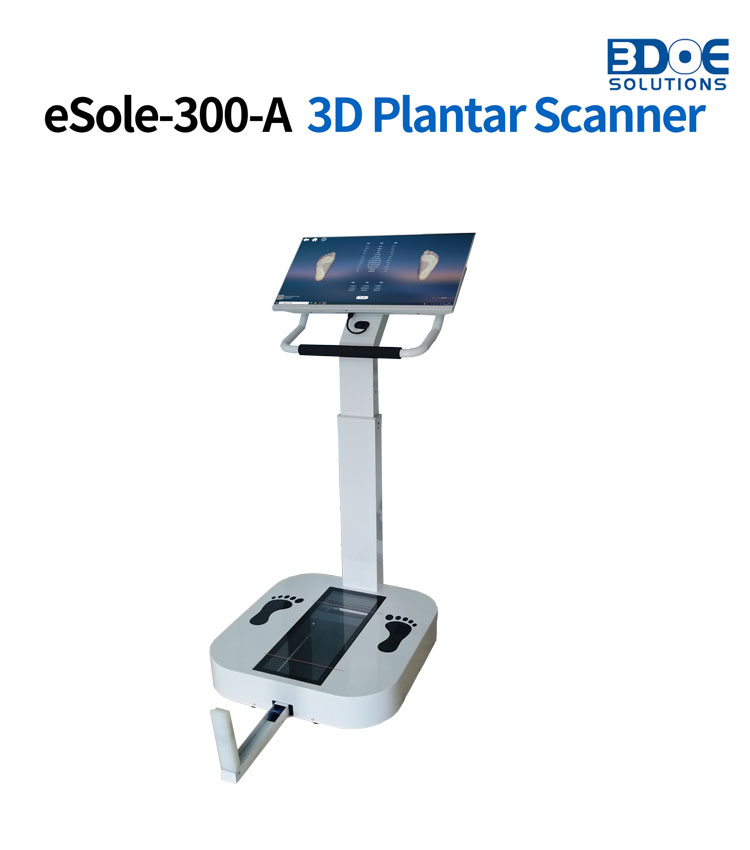
Compared with traditional image recognition or mechanical contact measurement, laser scanning has several significant advantages:
First is high resolution. The laser beam can be focused to the micron level, and conventional equipment resolution can reach 0.5 mm. Therefore, the constructed 3D plantar model has clear structural layers and defined boundaries, even capturing the undulations between toes.
Second is high stability. Laser scanning does not rely on external light, is unaffected by foot sweat or skin color, and has strong anti-interference ability, which allows it to maintain stable data in various usage scenarios.
Thirdly, the error is extremely small. High-quality laser scanning devices on the market are equipped with self-calibration modules and intelligent data fitting algorithms, which can automatically correct slight deviations, keeping the error within 0.5 millimeters.
What does this mean? It means the scanned foot shape can be directly used for precise processing, custom insoles, medical orthopedics, and sports foot molds, without requiring manual re-measurement or correction, saving time and greatly improving professional accuracy.
Nowadays, whether in rehabilitation centers, sports medicine institutions, or high-end insole customization workshops, laser plantar scanning has become the mainstream choice. The precision of technology is gradually changing our foot experience step by step.
Do not underestimate this 0.5-millimeter error; behind it lies a whole set of precise optical structures, algorithm logic, and engineering design. For the sole, a part with complex structure and varied curves, achieving this precision is already a very advanced technical level.
Therefore, when you step onto the plantar scanner, do not underestimate this small device; it may understand your feet better than you do.
If you are interested in plantar scanning devices, data applications, or personalized customization, feel free to leave a message. We will continue to share more stories behind this professional technology.