Are 3D Intelligent Foot Scanners Accurate?!
1. A person, whether to understand their own foot structure, or to optimize gait efficiency, or to reduce sports injuries, or as a professional who needs stricter evaluation of foot data, must perform more rigorous assessments.
Truly effective judgment is never based on subjective guessing, experiential inference, or vague observation. It allows the real three-dimensional shape to be captured, details to be expressed in numbers, and structures to be analyzed.
On every foot surface, there are hidden subtle curvatures, tilts, rotations, and height differences, and only through quantifiable scanning can these pieces of information form a real and reliable data system.
Every segment of gait trajectory also contains changes in speed, rhythm, and posture, and these details, which are not easily perceived by the naked eye, require high-speed capture by instruments and algorithmic integration.
If a person relies merely on visual observation or subjective feeling to determine foot type, then even if a conclusion is reached, it is only a temporary understanding—an interpretation of partial information under conditions of error.
People’s misunderstanding of their bodies often arises because they lack precise quantification; the limitations of experience exist because there is no evidence available to verify it.
A person with true scientific thinking can transform ambiguity into measurable, traceable numbers, using objective data to improve decision accuracy.
The core value of the 3D intelligent foot scanner is that it awakens accurate understanding of foot structure.
It allows hidden forms to be revealed, complex changes to be recorded, and analysis to shift from subjective to objective.
When an individual has clear data visualization, physical improvement naturally gains direction and no longer drifts in blind searching.
And once precise measurement establishes a stable pattern, the results often exceed expectations — many changes begin at that very moment.
2. Judgments lacking scientific basis usually cannot support long-term body management; and if measurements are not accurate enough, they cannot support real and effective analysis.
Modern sports science and ergonomics hold that the foot, as the starting point of all posture chains, often relies on subtle differences in its three-dimensional structure to determine overall stability and coordination.
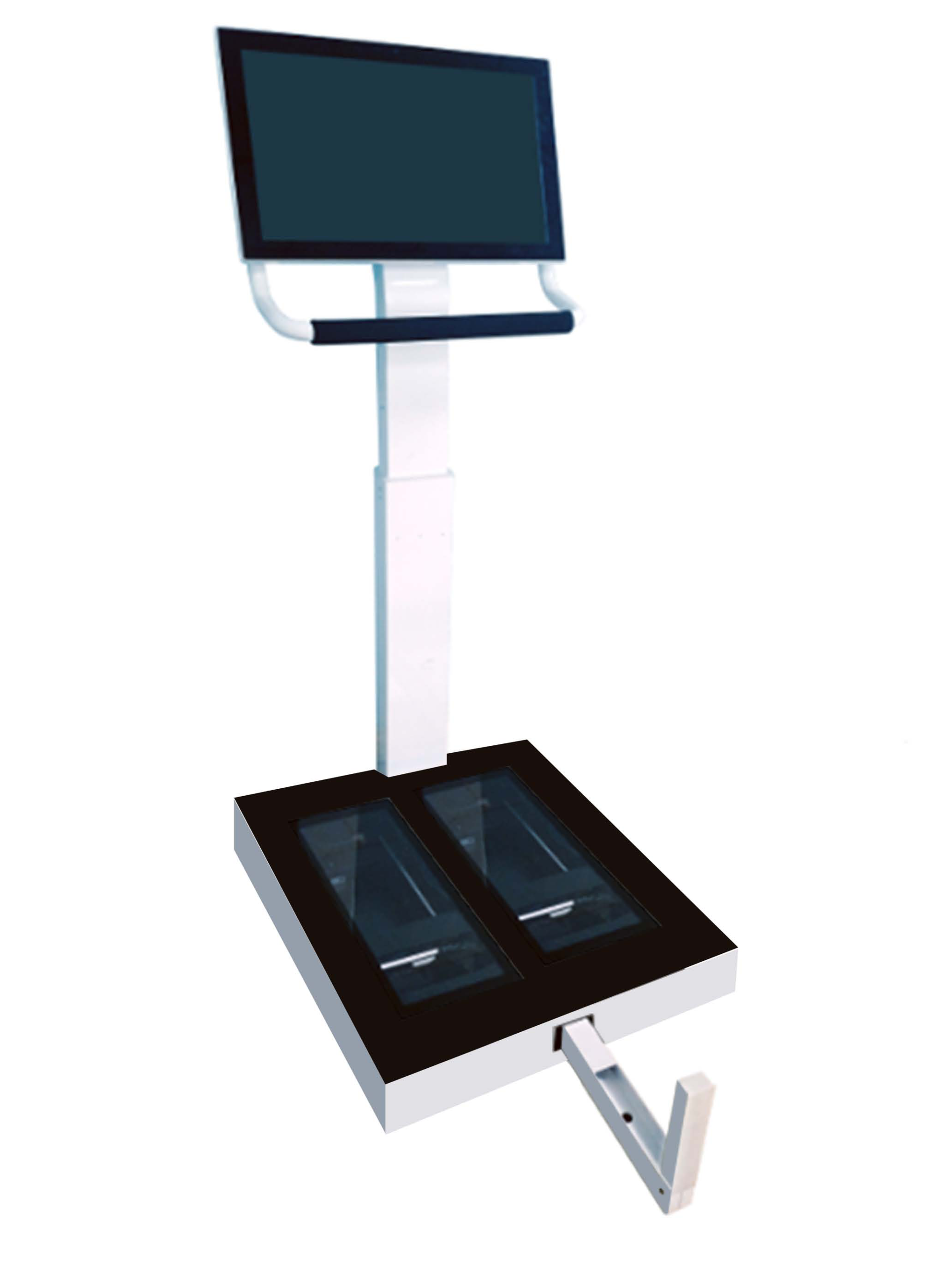
The widespread application of 3D intelligent foot scanners lies in their ability to capture real morphology through optical acquisition and restore foot structure through spatial modeling.
Optical scanning can achieve high-resolution geometric capture, allowing the dorsal foot, arch, and lateral foot contours to be displayed in 3D.
Algorithmic models fit these point-cloud data and construct a complete three-dimensional form, making foot height variations, local deformations, and overall orientation clearly visible.
This measurement method does not depend on personal perception but instead relies on repeatable engineering technology to avoid bias that occurs in traditional judgment methods.
When using such devices, we also need to approach data with an open and rigorous mindset—not fixating on a single indicator, not misinterpreting the model’s presentation, but viewing the foot’s structure through a systematic lens.
When an individual’s cognitive frequency shifts from subjective experience to scientific measurement, the world they see becomes different.
The more precise the data, the more it can guide people onto the correct path; the more comprehensive the model, the deeper the understanding it provides.
This statement is not exaggerated—it is a true reflection built upon technological capability.
Precise measurement has no exaggerated boundaries, but its reliability will continue to attract professionals due to its rigor.
3. A scientific evaluation process is not formed by a single technology, but by cooperation among multiple steps such as acquisition, modeling, calibration, and validation.
When the optical system reaches a certain resolution, it can capture subtle surface textures of the foot.
When spatial modeling algorithms become mature, they can merge scattered point clouds into a continuous three-dimensional structure.
Once data calibration reaches a stable state, repeated measurement error can be controlled within an acceptable range.
Reaching this level allows reliable reproduction of foot geometry.
But its deeper meaning is: people are no longer confined to judgment by the naked eye, and can instead examine the body through a higher-level model, moving away from “guess-based understanding” and toward “evidence-based cognition.”
When an individual no longer regards foot shape as a vague concept, but instead understands its structural logic through a visualized model, they can adjust their foot condition from a more reasonable perspective.
One’s own eyes are not the basis for judgment, and sensations are even less scientific.
Everything visible is captured objectively by instruments and calculated through models; the real key lies in how these structures are interpreted.
By using three-dimensional scanning to reveal forms that could not be accurately captured traditionally, you can understand your own body with clarity, enabling more scientific self-management.
Such a way of understanding makes you clearer than before and makes structural analysis more reliable.