Flatfoot, high arch, sagging arch, abnormal gait… these problems not only affect the health of the foot, but also put pressure on the knee joints and spine.
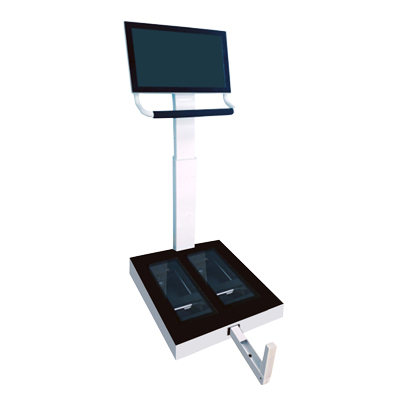
Just as optical devices can accurately measure eyesight, the flatfoot measuring device also use laser principles to scan the contours of the foot, providing the scientific basis for the diagnosis of arch abnormalities.
The measuring device can display the arch and generate an accurate 3D model for subsequent interference and correction reference. So what exactly does a flatfoot measuring device that uses laser principles do? This is reflected in the following:
I. Accurately capture the 3-D shape of the foot.
Laser Scanning Arch
Using a laser beam to scan the surface of the foot, the device captures key structural parameters such as arch height, length and width.
For flatfoot patients, the collapsed area of the arch of the foot can be clearly seen, while the raised shape of high arch can be accurately replicated to create an intuitive model.
3D modeling, etc.
Laser data can be processed to produce a three-dimensional model of the foot and display the arch and contour curves of the spatial structure.
This visual model is intuitive and allows scientific comparisons to determine the arch’s normal state and the extent of collapse.
ii. Quantification of key indicators
Calculate arch height
Laser measurements automatically capture the highest and lowest points of the vault and produce numerical height indicators.
Doctors or orthopedic surgeons can use these metrics to determine whether the arch meets normal standards and avoid errors in visual judgment.
Measure the collapse area.
The device also displays the length and width of the collapsed arch, providing a quantitative basis for the severity of the flattened foot.
Compared with traditional footprint methods, laser measurement is more accurate, repeatable and scientific.
III. Assisted in personalized correction
Custom three-dimensional insoles
The model of foot produced by laser can be applied directly to custom orthopedic insoles, so that the the insole can fit the shape of arch accurately.
For collapsed flat feet, the insole provides scientific support to improve gait and reduce joint load.
Guide the development of intervention plans
The results of laser measurement can provide reference for rehabilitation training, foot correction and shoe selection.
For example, during the development of a child’s flat foot, scientific intervention plans can be formulated using laser data, dynamically tuned to changes in the arch of the foot.
IV. INTRODUCTION Scientific documentation and tracking
Generate data archives
A 3D model of the foot after laser scanning can be saved as an electronic record to track changes in an individual’s foot.
Changes in arch height and shape can be compared to verify the results of intervention during long-term monitoring of correction effects.
Basis for research and design
Data from laser measurement can be used in the development of footwear, orthopaedics and rehabilitation equipment to ensure that designs are better aligned with foot structures.
By accumulating extensive amounts of data, researchers can analyze differences in age and foot type to support scientific corrections.
The flat-footed measuring device based on laser principles can not only scan the arched contour accurately, but also produce a quantifiable and visualizable three-dimensional models.
It provides scientific basis for the diagnosis, intervention and individualized correction of flat foot, so as to ensure the health of the foot more accurately.