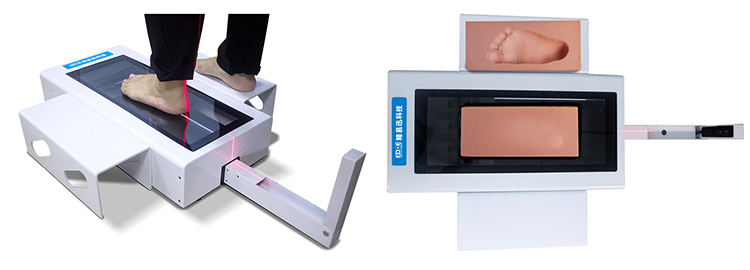
Flat feet, high arches, out-toeing, foot eversion, bunions, X/O-shaped legs… these foot problems not only affect gait but may also lead to discomfort in the knees, hips, and even the lower back. Just as corrective insoles can provide scientific support for different foot types, a 3D laser foot scanner can accurately measure the plantar shape, providing the data basis for customizing corrective insoles.
One, precise measurement of the plantar shape
- Comprehensive scanning of the sole
The 3D laser foot scanner has the ability to capture holographic information of the sole in a very short time. This information includes arch height, distance between toes, and foot shape contours. For patients with flat feet, the scanner can precisely measure the range and morphological characteristics of the collapsed arch, providing a scientific basis for insole correction. - Dynamic analysis of gait
Modern scanners also support dynamic gait analysis to record gait trajectories during walking or running. This data can assist professionals in evaluating foot shape and gait abnormalities, enabling the customization of insoles that better conform to biomechanical principles.
Two, personalized customization of insoles
- Different foot types
Individual foot shapes and gait patterns vary, so effective corrective insoles must be designed based on precise measurement results. The detailed data provided by the 3D laser foot scanner can be used to manufacture personalized insoles that support the arch and improve gait, ensuring that each insole fits the user’s foot perfectly. - Adaptable to different age stages
Children, adolescents, and people whose foot shape changes due to injury or illness may experience alterations in plantar morphology over time. This utility model customizes insoles based on scanning data, adjusting design and material according to foot development or recovery needs to ensure long-term effectiveness.
Three, high-quality materials and technology
- Material selection
Common polymer materials for personalized insoles include EVA, TPU, and PP, which provide both elasticity, support, and durability. For patients with flat feet, the mid-arch support area of the insole is usually made of a medium-hardness material, while cushioning areas use soft and elastic material to enhance comfort. - Precise craftsmanship
The insole adopts advanced cutting, forming, and bonding processes that accurately match the foot scan data, ensuring stability in size and shape. Smooth edges prevent irritation of the foot’s skin and resist deformation or delamination from long-term use.
Four, comfort and adaptability
- Comfortable fit
Custom insoles need to provide scientific arch support while ensuring wearing comfort. The personalized design provided by the 3D laser foot scanner allows the insole to fit perfectly within the shoe, preventing sliding or curling and providing a stable and comfortable wearing experience. - Easy adaptation
Scientifically designed insoles enable the user to adapt quickly without affecting normal walking or activities. The insoles mimic the comfort of regular insoles while correcting gait, allowing users to gradually improve issues caused by flat feet in daily life.
Five, promoting foot health and improving quality of life
Using a 3D laser foot scanner to precisely measure plantar morphology, combined with personalized corrective insoles, can effectively improve gait abnormalities caused by flat feet and reduce the risk of uneven stress on the knees and hips, allowing users to walk, run, and carry out daily activities with ease.
The 3D laser foot scanner combined with customized corrective insoles provides a scientific, accurate, and comfortable foot improvement plan for people with flat feet, making every step stable and confident.